Introduction: Titanium Costs 3x More Than Steel — Is It Worth the Markup for Your Customers?
We manufacture both. Every day, our CNC machines cut ASTM F-136 titanium and 316L surgical steel into labrets, haltères, clics, and nose rings. So we don’t have a horse in this race — we sell both materials, and we’ll tell you honestly when each one makes sense.
The short version for piercing studio owners and retailers:
• Sell titanium for: nouveaux piercings, nickel-sensitive clients, any piercing that needs color anodizing
• Sell 316L steel for: budget-friendly options, healed piercings, industrial barbells where weight is less of a concern
The rest of this guide breaks down the material science, the cost math, and the real-world wear data from our clients’ feedback across 30+ countries.
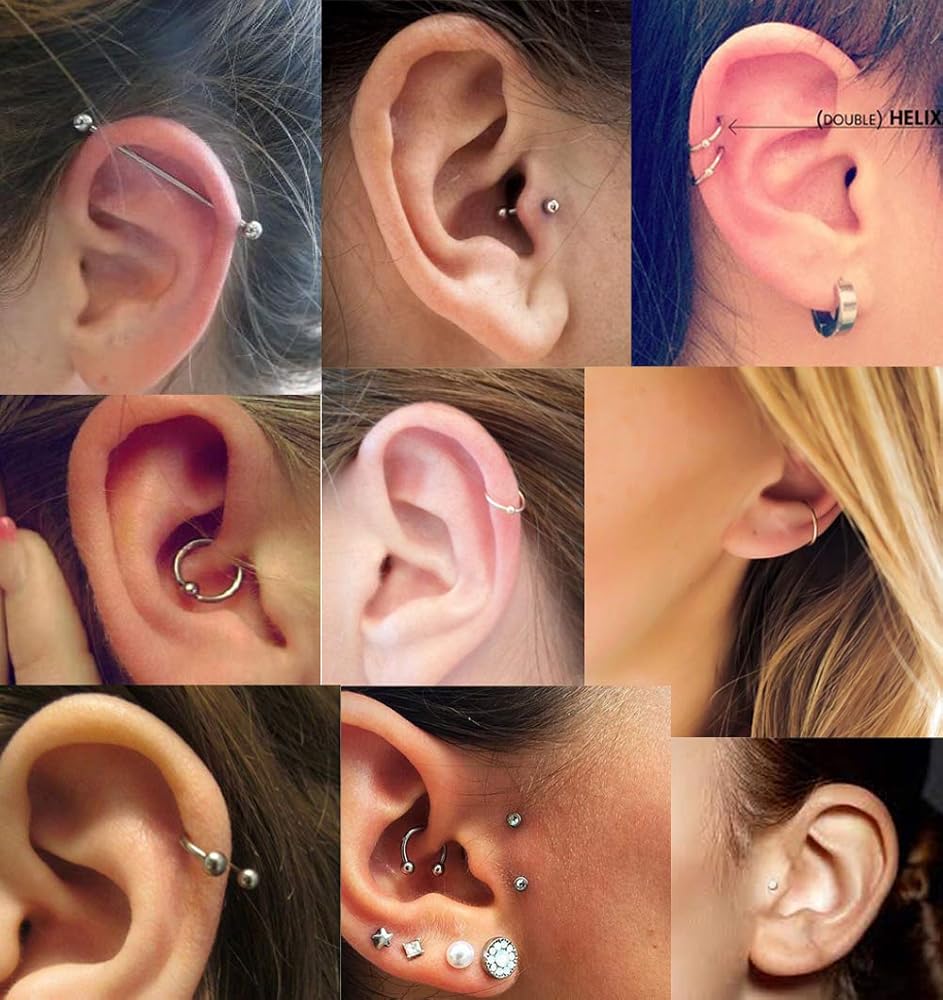
Material Options at a Glance — What Actually Works in Piercing Jewelry
Not every material belongs in a fresh piercing. Here’s the shortlist of what we actually recommend based on a decade of manufacturing and client feedback:
ASTM F-136 Titane (G23) — Medical implant grade. Zero nickel risk. Can be anodized to 30+ couleurs. Costs more, but we’ve never had a verified allergic reaction.
316L en acier chirurgical (ASTM F-138) — Industry workhorse. Great durability-to-cost ratio. Contains 10-14% nickel, which triggers reactions in roughly 1-2% of wearers. Still the best value option for healed piercings.
18K or / 925 Argent — We don’t recommend these for initial piercings. Gold alloy contains nickel. Silver tarnishes and can cause argyria. Fine for healed ears, not for fresh piercings.
What Our CNC Operators Notice First About Titanium
Titanium machines differently than steel. It’s gummier — generates more heat during cutting, which means tool wear is higher and feed rates need adjustment. That’s why cheap titanium jewelry often has rough threading: the factory cut corners on tooling costs.
Where titanium genuinely wins:
• First piercings. The lighter weight means less gravitational pull on a fresh piercing. Clients with titanium labrets consistently report faster healing in our follow-up surveys.
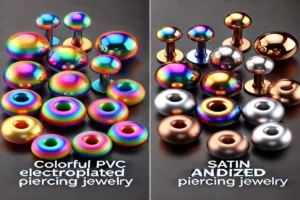
• Color without plating. Anodizing titanium creates an oxide layer that’s part of the metal — not a coating. It won’t chip, peel, or flake. Nous offrons 30+ anodized colors, from rose gold to deep purple to jet black.
• Nickel-safety guarantee. At less than 0.05% contenu en nickel, we’ve never had a verified allergic reaction to our F-136 titanium.
Where titanium falls short:
• It scratches. An industrial barbell worn daily shows micro-scratches within 6-12 mois. Steel holds its polish longer.
• It costs 30-50% more at retail. For budget-conscious product lines, that margin matters.
316L Steel Is the Workhorse of the Piercing Industry — Here’s Why
Where steel genuinely wins:
• Durability-to-cost ratio. An industrial barbell in 316L can withstand years of daily wear and hold a mirror finish. For the price, there’s no better value.
• Weight feel. Some customers prefer the heavier feel — it signals quality. Belly rings and industrials in steel feel more substantial.
• Better scratch resistance. Steel’s higher hardness resists surface abrasion better. For jewelry that gets bumped frequently, steel holds up visually.
Where steel creates problems:
• The nickel question. 316L contains 10-14% nickel. Most people tolerate it fine. But for fresh piercings — especially cartilage and nose — the lower nickel content of titanium gives measurably better healing outcomes. If a client says they react to “cheap jewelry,” they’re almost certainly reacting to nickel migration from steel.
• No color customization. Steel can’t be anodized. Colored steel is either PVD-coated or electroplated — both wear off. We’ve had clients return PVD-coated pieces after 3 months of daily wear with visible fading at the contact points.
• Heavier = more droop. A steel curved barbell in a navel piercing puts more downward pressure than titanium. For clients with thin tissue or healing navels, titanium is safer.
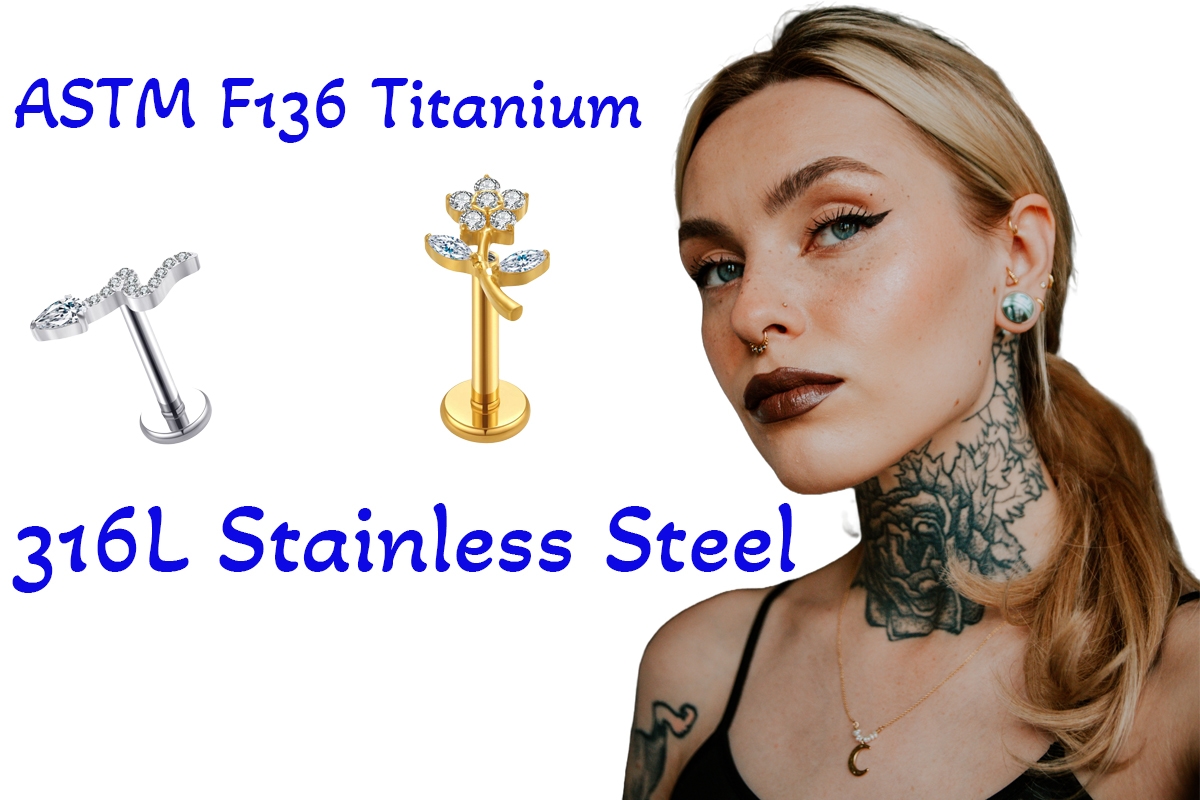
Comparaison: ASTM F136 Titanium VS. 316L Acier inoxydable
Tandis que les deux ASTM F136 Titane et 316L Acier inoxydable sont d'excellents matériaux pour les bijoux perçants, Il existe certaines différences qui peuvent rendre une plus appropriée que l'autre pour des applications spécifiques. Voici une comparaison rapide:
| Propriété | ASTM F136 Titane | 316L Acier inoxydable |
|---|---|---|
| Résistance à la corrosion | Excellent, Très résistant à la corrosion, surtout dans les fluides corporels | Bien, mais peut corroder dans certaines conditions, Surtout avec les chlorures |
| Biocompatibilité | Hautement biocompatible, Le faire idéal pour les piercings corporels et les implants médicaux | Bien, mais peut provoquer des réactions chez les individus sensibles |
| Durabilité | Très durable, résistant aux rayures et à l'usure | Durable mais moins résistant aux rayures par rapport au titane |
| Poids | Léger, le rendre confortable pour une usure prolongée | Plus lourd que le titane, qui pourrait être moins confortable pour certains porteurs |
| Prix | Plus cher en raison du processus de haute qualité et de fabrication du matériau | Plus abordable, couramment utilisé pour les bijoux de marché masse |
| Propriétés hypoallergéniques | Généralement hypoallergénique, Idéal pour les personnes souffrant de sensibilités en métal | Bien, Mais certains utilisateurs souffrant d'allergies au nickel peuvent avoir des réactions |
| Apparence | Peut être anodisé pour une large gamme de couleurs et de finitions | Peut être poli pour un brillant, apparence brillante, Mais pas d'options de couleurs comme le titane |
How to Stock Your Studio: B2B Buying Guide for Material Selection
Here’s the inventory split that works for most of our B2B clients:
Stock more titanium if:
• Your client base skews toward first-time piercings
• You’re positioning your brand as premium / hypoallergénique
• You want to offer colored jewelry without coating failure risk
• Your clients have reported nickel sensitivities with other brands
Stock more 316L steel if:
• You’re building an entry-level / budget product line
• Industrial barbells and heavy-gauge pieces are your bestsellers
• Your clients prioritize scratch resistance over weight savings
• You need to keep retail prices competitive
The sweet spot: Most of our B2B clients order a 60-40 split — 60% titane, 40% acier. That gives you the premium positioning of titanium while keeping average order costs manageable. We’ve seen this ratio work across piercing studios in the US, Europe, and Australia.
Both Materials Work — The Question Is Which One Fits Your Product Line
We manufacture both materials — same factory, same CNC machines, same polishing team, same QC standards. If you’re building a piercing jewelry inventory and want unbiased advice on material selection, our B2B team can walk you through the cost analysis.
Request:
• Wholesale price list (titane + steel — side by side)
• Material comparison PDF with full technical specs
• Free sample pack (mix of both materials)
Wholesale Titanium and Steel Jewelry from Sensagem
Looking for a reliable titanium body jewelry manufacturer? Explore our wholesale titanium and steel collections or contact our team for OEM & private label support.
Explore Wholesale Collections · Contact Our Team
FAQs from B2B Buyers
Est ASTM F136 Titanium mieux que 316L en acier inoxydable?
Most studios stock 60% titanium and 40% acier. Titanium covers fresh piercings and sensitive clients, while steel covers the budget-conscious segment. We offer wholesale pricing on both, with a MOQ of 10 pcs per SKU for in-stock models.
Puis-je utiliser en acier inoxydable 316L pour tous les types de piercings?
Oui. We send free samples to qualified B2B buyers — a mix of titanium and steel, your choice of styles. You can verify the quality, finition, and feel before committing to a bulk order.
How do I know if a supplier’s “titanium” jewelry is real ASTM F-136?
Ask for the mill test report (MTR). Every batch of genuine F-136 comes with a certificate documenting the chemical composition. We provide one with every shipment. Counterfeit titanium is a real problem in this industry — the MTR is your only reliable verification.
En suivant ces directives et en choisissant les bons matériaux pour les bijoux perçants, Vous pouvez assurer une expérience positive à vos clients et maintenir les normes élevées de votre marque.
F136 Titanium vs 316L: Idéal pour les bijoux de perçage · Piercing Jewelry Certification Guide